Irish Accent
An Irish accent is not a single thing. The accents of Ireland differ sharply by county and coast — a Dublin accent, a Galway accent, a Cork accent and a Belfast accent are all immediately distinguishable to an Irish ear. The broadest split is between southern Irish accents (the Republic) and Northern Irish accents, which carry a Scottish-influenced sound reflecting centuries of settlement. Most Irish accents are rhotic, pronouncing every R.
Where this accent is from
Irish accent covers more than one place, and the recordings are grouped by each of them:
Hear it from real speakers
Every recording below is an unscripted native speaker, not an actor performing the accent — the reference that actually matters when you're learning it.

Dublin Accent
Dublin, IrelandWatch
Galway Accent
Galway, IrelandWatch
Irish Accent
Curragh, County Kildare, IrelandWatch
Irish Accent
Churchtown, County Dublin, IrelandWatch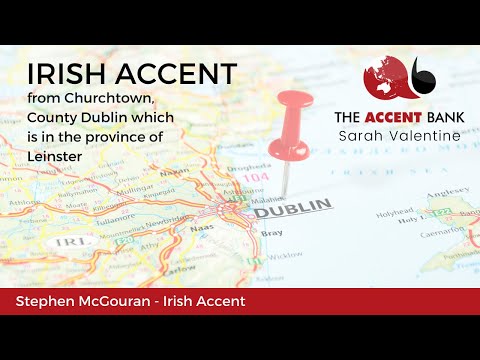
Irish Accent
Churchtown, County Dublin, IrelandWatch
Dublin Accent
Dublin, IrelandWatch
Irish Accent
Slough/Dublin, IrelandWatch
Dublin Accent
Dublin, IrelandWatch
Belfast Accent
Belfast, Northern IrelandWatchWhat actually separates them
The differences that matter when you're learning it — not the version you'd get from a vocabulary list.
- Southern vs. Northern
- The border is audible. Southern Irish accents have a lighter, more open vowel quality and a distinctive intonation that rises at the end of phrases. Northern Irish accents are shaped by Scots settlement — tighter vowels, a harder R, and a markedly different rhythm that an Irish listener places instantly.
- Dublin is not Ireland
- Dublin accents are the most exported and therefore the most over-represented, which leads actors to build a generic "Irish" from them. Coastal and western accents such as Galway and Cork are noticeably different, and casting directors working on Irish-set productions increasingly ask for something more specific than "Dublin".
- The rhotic R
- Irish English is rhotic, so "car" and "hard" keep their R — unlike RP and most English accents. The Irish R is also a tapped sound rather than the American approximant, which is subtle but is one of the clearest tells of whether an actor has actually listened to Irish speakers rather than working from an American accent with the vowels shifted.
- Intonation carries the identity
- The Irish rise — a distinctive upward movement in the pitch of a sentence — is more important to sounding Irish than any individual vowel. Actors who nail the vowels but keep flat English intonation are almost always identified as not Irish within a sentence.
Common questions
What is the difference between an Irish and a Northern Irish accent?
Northern Irish accents are shaped by Scottish settlement and sound closer to Scottish English: tighter vowels, a harder R and a different rhythm. Southern Irish accents are generally more open and melodic. The two are distinct enough that Irish audiences place a speaker by them immediately.
Is a Galway accent different from a Dublin accent?
Yes, noticeably. Galway and the west of Ireland have a lighter, more open vowel quality and a different intonation pattern from Dublin. To an Irish ear the difference is as clear as the difference between a Texan and a New Yorker.
Do Irish accents pronounce the R?
Yes. Irish English is rhotic, so the R in "car" and "hard" is pronounced. The Irish R is a tapped sound, which is different from both the silent R of RP and the American R.
Working on Irish accent for a role?
The recordings on this page are the reference. If you need correction, direction and someone to tell you when it's right, Sarah teaches this one-to-one — and there's a self-paced course if you'd rather work alone.